Summary:
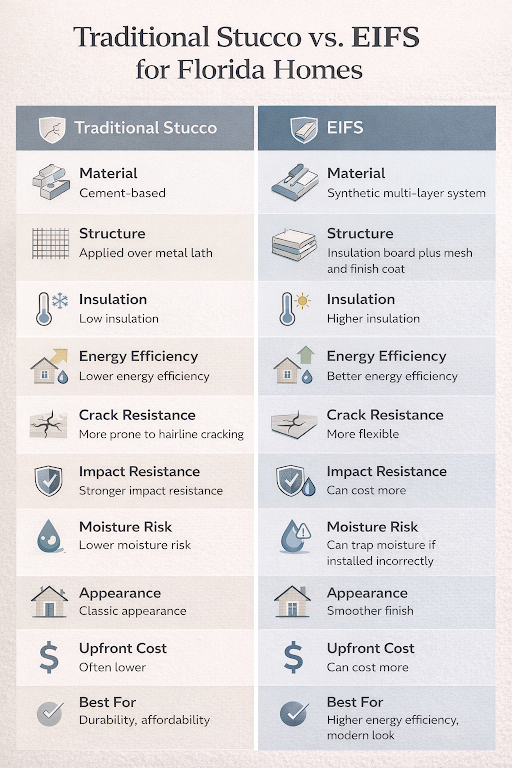
| Feature | Traditional Stucco | EIFS |
| Material | Cement-based | Synthetic multi-layer system |
| Structure | Applied in coats over metal lath | Insulation board, mesh, base coat, finish coat |
| Insulation | Low | High |
| Energy | Lower | Better |
| Crack resistance | More prone to hairline cracking | More flexible, often less visible cracking |
| Impact resistance | Stronger, harder surface | Can be more vulnerable to dents |
| Moisture risk | Can absorb moisture through cracks | Can trap moisture if installed incorrectly |
| Appearance | Traditional, solid look | Smooth, versatile finish options |
| Upfront cost | Often lower | Can be higher depending on the system |
| Best for | Homeowners prioritizing durability and traditional finish | Homeowners prioritizing insulation and flexibility |
If a Category 4 storm is 48 hours out, are your exterior walls ready?
In Florida, the danger is the constant exposure to heat, humidity, and wind that slowly breaks materials down long before a storm arrives.
According to Sarasota Bradenton International Airport, in just a 24-hour period, temperatures ranged from the mid-50s to mid-70s°F. The humidity levels also consistently hovered between 50% and nearly 60% overnight with steady coastal winds.
Florida does not give you a second chance. Any hidden weakness gets exposed the moment a storm hits.
Yet, most homeowners across Florida choose their exterior material based on what the contractor prefers or what fits the budget that week. They don’t choose based of what actually survives in this climate.
This is where the materials EIFS and traditional stucco come in. However, they might look nearly identical on a finished home, but they perform very differently.
Let’s learn about the difference between EIFS and stucco.
Traditional stucco is a historic, lime-based plaster used for exterior and interior wall finishes. It is also called hard coat stucco. This plaster is known for its breathability and durability.
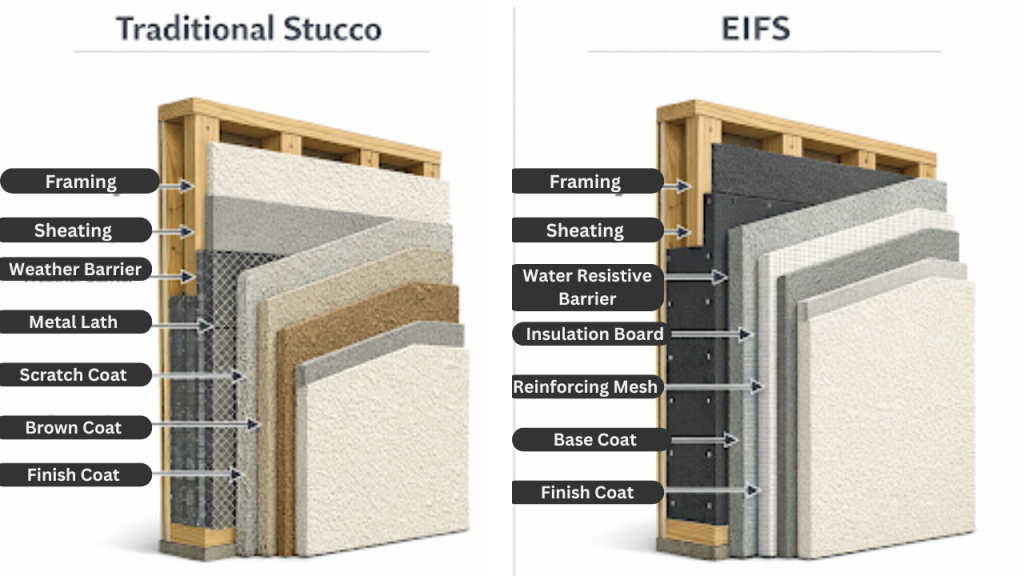
The exterior insulation and finish system consists of:
This mixture allows moisture vapor to pass through while the lime cures slowly through carbonation. This creates self-healing properties over time.
Traditional stucco is applied in three coats over lath:
The finish is hand-troweled into textures such as smooth, sand, or rough using artisan techniques for a natural, varied appearance.
It offers low insulation but excels in humid climates due to its vapor permeability and develops an aged patina.
EIFS stands for Exterior Insulation and Finish System. It is sometimes called synthetic stucco, but it is not the same as traditional cement stucco. It is a modern, multi-layered cladding used on building exteriors for insulation and aesthetics.
It typically includes:
A water-resistive barrier sits beneath to manage moisture.
EIFS provides continuous insulation to boost energy efficiency and reduce thermal bridging. It also offers design flexibility, with a range of colors and textures. Unlike traditional stucco, it is:
EIFS in construction is specifically designed to replicate the look of traditional stucco.
EIFS uses special synthetic coatings (like acrylic layers) that are applied and shaped to look like real stucco. Builders can create different textures (smooth, sandy, or rough) so that from a distance, it looks just like the classic plaster finish.
It can even be made to look like brick or stone with more color options.
| NOTE: In Florida, the cracks in EIFS should never be ignored. If you are seeing surface issues, it helps to understand the common stucco problems (cracks, water damage) and how to fix them. |
Traditional stucco can be more affordable upfront in some applications, especially for simpler installations. EIFS may involve additional components and detailing, which can affect both material and labor costs. Final pricing depends on the:
EIFS needs less routine maintenance than traditional stucco due to its flexible synthetic finish. However, both need attention to prevent moisture issues. Stucco usually needs ongoing attention to cracks and surface wear, especially as the home ages.
Modern drainable EIFS lasts 40-60 years or longer due to moisture management and flexible acrylic finishes that resist cracking. Older barrier EIFS may fail in 15-40 years due to trapped water, while high-impact or polymer-modified versions exceed 50 years with annual inspections.
For Florida homes, the biggest issue is whether the exterior system was installed properly and whether it is being maintained correctly.
Along the Gulf Coast, moisture management is critical. Heavy rains, humidity, salt air, and long-term sun exposure can all shorten the life of an exterior system if cracks, weak seals, or drainage issues are overlooked. If energy performance is one of your priorities, you may also want to read more about stucco and energy efficiency.
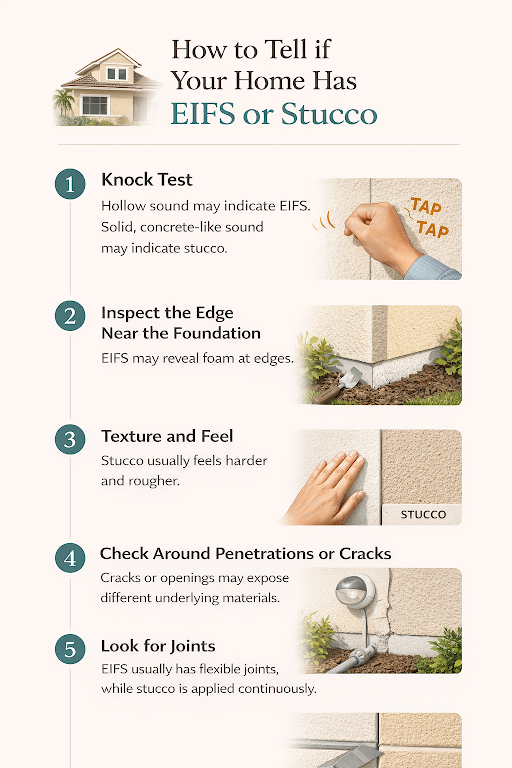
Tap the wall gently. A hollow sound indicates EIFS (foam insulation). A dull, solid, concrete-like sound indicates traditional stucco.
Look at the bottom edge of the siding near the foundation. EIFS often sticks about 3/4 of an inch and may reveal foam. Traditional stucco goes directly down to the foundation.
EIFS feels softer and warmer. Traditional stucco is very hard and can be abrasive or feel sharp to the touch.
Look inside the hole to see cracks around windows or fixtures. White styrofoam behind the wall finish means it’s EIFS.
EIFS usually has wider joints that are sealed to allow movement. Traditional stucco usually does not have these wide sealed joints.
| NOTE: A professional inspection is the best way to confirm what system is in your home and whether there are any early signs of damage. Consider stucco repair services if you already know the exterior is damaged. |
Yes, you can buy a house with EIFS. But you need to be careful. A house with EIFS is not automatically a bad investment. What matters is whether the:
If you are buying a home with EIFS, it is wise to have the exterior evaluated by a contractor or inspector who understands moisture intrusion risk and exterior wall systems.

At Kinetic Stucco Restoration, we help homeowners across Sarasota and Manatee County:
Contact our team for a professional evaluation and honest recommendation.