Stucco finishes are the final decorative and protective layer applied to exterior walls, available in seven distinct texture types ranging from silky smooth to heavily pebbled. Choosing the right stucco texture determines how your home looks, how well it resists Florida weather, and how much maintenance it will need over the years.
If you own a home in Sarasota, Bradenton, or anywhere along Florida’s Gulf Coast, there is a very strong chance your walls are already coated in stucco. Between 70 and 82 percent of homes in southern Florida rely on stucco siding. And yet, most homeowners have never been told what kind of stucco finish they have or whether it is actually the best option for their property. This guide changes that.
By the end, you will know every major stucco texture type, what it looks like, and exactly which one suits your home.
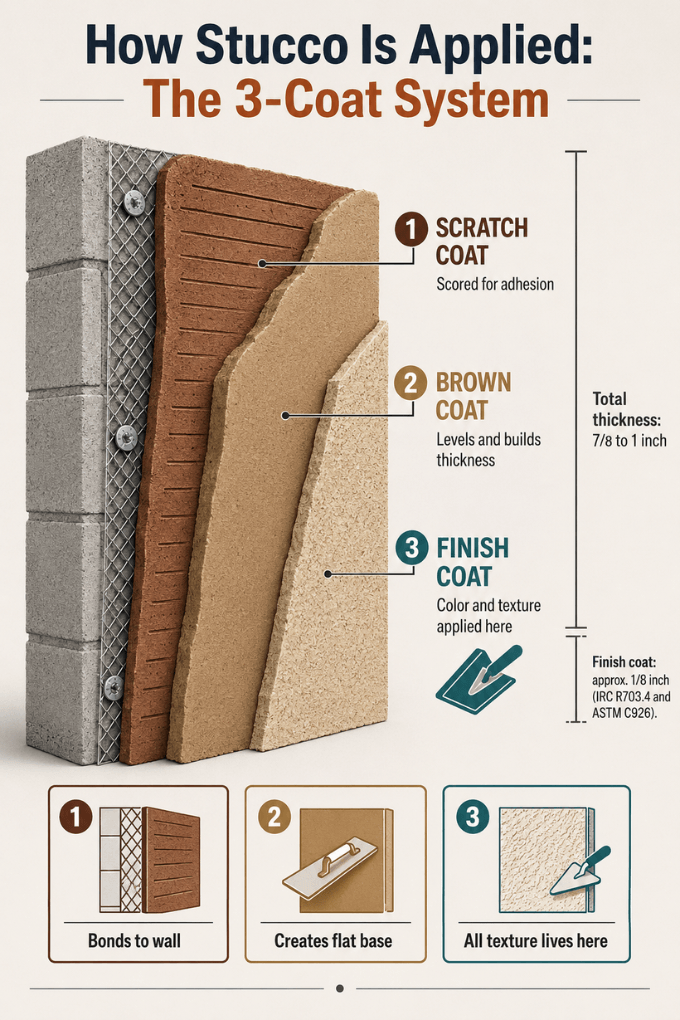
Before comparing finish types, it helps to understand how stucco is applied to a wall. Contractors apply it in three distinct layers, and the finish coat is where all the texture decisions happen.
Scratch Coat — The first layer is bonded directly to the wall substrate. It is scored with shallow grooves so the next coat adheres properly.
Brown Coat — The leveling layer. This coat builds thickness and creates a flat, even base for the finish.
Finish Coat — The visible outermost layer. This is where color is added, and texture is created by a mason using specific tools and techniques.
The full three-coat system typically reaches a total thickness of 7/8 to 1 inch. Per the 2024 International Residential Code (IRC) Section R703.4 and ASTM C926, the finish coat is applied at approximately 1/8 inch thick. That single, thin final layer is responsible for everything you see and feel on the outside of your home.
There are seven primary stucco texture types used on modern homes. Use this table as your fast reference before each one is explained in detail below.
| Finish Name | Visual Look | Best For | Maintenance | Repair Ease |
|---|---|---|---|---|
| Smooth Stucco | Flat, sleek, minimal | Contemporary and modern homes | Higher — cracks show clearly | Harder |
| Sand / Float | Fine, uniform grain | Most residential styles | Low | Easy |
| Lace Finish | Swirled, skip-trowel pattern | Florida coastal homes | Low | Easy |
| Dash Finish | Rough, pebbled surface | Commercial and high-traffic walls | Very low | Easy |
| Cat Face | Smooth surface with rough patches | Spanish and Mediterranean style | Medium | Harder |
| Monterey Finish | Layered, deep skip-trowel texture | Traditional estate homes | Medium | Moderate |
| Knockdown Texture | Flattened irregular peaks | Modern exteriors and interior ceilings | Low | Easy |
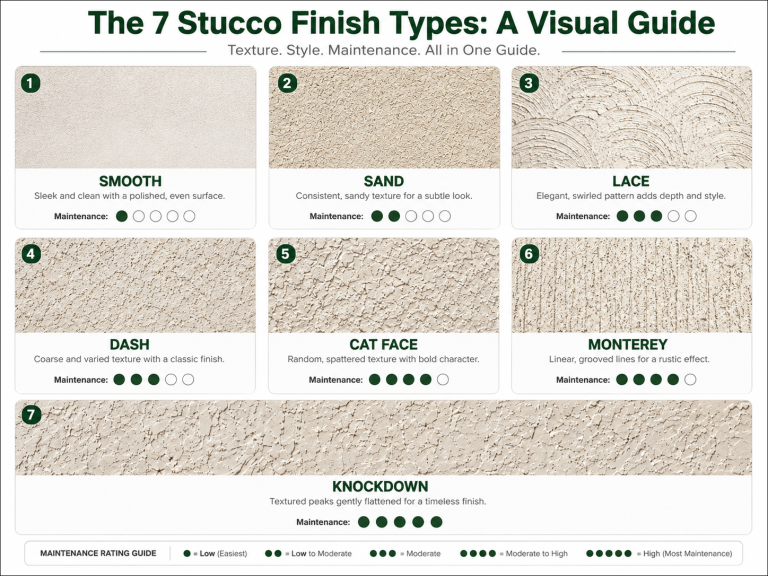
Here is a plain-English breakdown of each finish type so you can picture exactly what you would be getting on your home.
A smooth stucco finish is troweled completely flat until no visible texture remains. It produces a clean, modern surface that pairs perfectly with contemporary architecture featuring flat rooflines, geometric shapes, and minimal ornamentation.
The trade-off is that this finish shows hairline cracks more visibly than textured alternatives, which matters in Florida, where seasonal ground movement and heat expansion stress exterior walls year-round. It also requires the most skilled hand to apply well because every imperfection in the base coat is visible in the final result.
If pristine modern aesthetics are your priority and you are prepared for slightly more attentive maintenance, smooth stucco delivers a striking result.
The sand finish, also called a float finish, is arguably the most widely used stucco texture in residential construction. Real sand is blended into the finish coat mixture, and once applied, the surface is worked with a sponge float or rubber tool to produce a fine, uniform grain across the entire wall.
Coarser sand gives a more pronounced texture, while finer sand produces a surface that approaches smooth without quite reaching it. This flexibility makes the sand finish one of the most versatile stucco textures available. It is forgiving, accepts paint evenly, blends seamlessly with almost any architectural style, and is straightforward to patch when small areas need repair.
Lace finish, sometimes called skip trowel, is one of the most popular stucco textures throughout Southwest Florida, and for good reason. A mason sprays the material onto the wall and then lightly trowels it, leaving behind a swirled, organic pattern with peaks and valleys scattered across the surface.
Two variations exist. Light lace is subtle, with more flat areas and a gentle texture, giving the wall a refined look. Heavy lace features pronounced ridges and significant depth, adding strong visual character to the exterior.
Because the natural variation of lace texture conceals minor surface imperfections, it is an excellent choice for older homes undergoing restoration and for walls where matching an existing finish is not a concern.
Dash finish is the most durable of all stucco texture types. Coarse aggregate is sprayed forcefully onto the wall and left completely untroweled, creating a rough, heavily pebbled surface with maximum texture depth.
This finish resists scuffs, impact, and moisture penetration extremely well. You will find dash finish used frequently on commercial buildings, retaining walls, lower wall sections near landscaping, and any exterior surface where physical contact and harsh environmental exposure are daily realities. If longevity and minimal upkeep are the top priorities, dash finish is the practical champion of the group.
Cat face stucco, sometimes called California finish, is a technique where a mason deliberately leaves aggregate chunks exposed within an otherwise smooth surface. The result is a wall with flat, smooth areas interrupted by rough, rustic patches scattered throughout, creating an artistic and handcrafted appearance.
It suits Spanish, Mediterranean, and Old Florida architectural styles particularly well. The irregular pattern has a warmth and character that purely smooth or uniformly textured finishes cannot replicate. The important consideration is that matching the cat face for future repairs requires extra skill. When patching is needed, the random nature of the pattern makes seamless blending more challenging, which makes choosing an experienced contractor especially important.
The Monterey finish is a two-pass technique that creates depth no single-coat method can match. The mason applies a first layer with a skip trowel and allows it to set partially, then comes back with a second pass to add another layer of material over specific areas. The result is a richly layered surface with distinct shadow lines and three-dimensional character.
This finish suits traditional estate homes, luxury residential properties, and any building where the exterior is meant to make a strong architectural statement.
It takes longer to apply than most other stucco textures, which is reflected in the project cost, but the visual result is unmistakably premium.
Knockdown texture begins the same way as a lace finish. The material is sprayed onto the surface, but instead of being troweled with a swirling motion, the peaks are flattened with a wide trowel knife shortly after application. This creates an irregular, mottled surface with subtle dimension and gentle variation across the wall.
It is one of the most repair-friendly finishes available because the random nature of the flattened peaks makes blending a new patch into the surrounding area relatively straightforward. Knockdown is popular for both interior ceilings and modern exterior walls, and its understated texture complements a wide range of home styles.
Kinetic Stucco Restoration offers free, no-obligation consultations for homeowners across Sarasota and Manatee County. Our veteran-owned team will walk your property, assess your existing stucco, recommend the best finish for your climate and architectural style, and give you a fully transparent quote with no hidden costs.
Call us today: +1 (941) 298-3562
Picking a finish type is not purely an aesthetic decision. Three practical factors should guide your choice before you speak with a contractor:
Modern or Minimalist → Smooth Stucco or Knockdown Texture
Spanish or Mediterranean → Cat Face or Monterey Finish
Coastal Ranch or Florida Traditional → Lace Finish or Sand Finish
Commercial or High Traffic → Dash Stucco Finish
Classic Estate or Luxury → Monterey or Heavy Lace
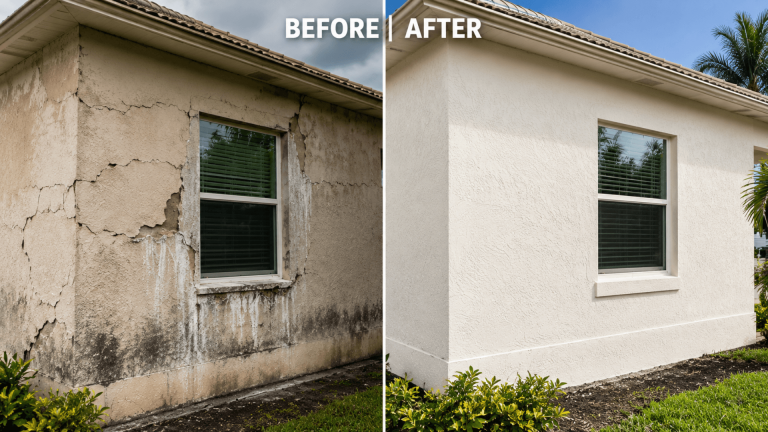
Understanding stucco texture and finish types is the first step toward making a confident decision about your home’s exterior. Whether you are drawn to the sleek look of smooth stucco, the timeless appeal of a lace finish, or the rugged durability of a dash finish, each texture has its strengths and ideal use case. The key is matching the right finish to your home’s architecture, Florida’s climate demands, and your long-term maintenance goals.
With over two decades of stucco expertise and a veteran-owned commitment to quality craftsmanship, Kinetic Stucco Restoration helps homeowners across Sarasota, Bradenton, St. Petersburg, and Siesta Key choose the right finish, apply it correctly, and keep it looking exceptional for decades to come.
The seven main stucco texture types are smooth, sand, lace, dash, cat face, Monterey, and knockdown. Each is created using a different finish coat technique and suits different architectural styles and climate conditions
Lace finish and sand finish are best for Florida’s Gulf Coast climate. Both handle humidity well, naturally conceal hairline cracking from thermal expansion, and accept masonry paint easily for routine maintenance, repainting every five to ten years.
A properly installed stucco exterior lasts 50 to 80 years. Annual inspections catch early cracks before moisture enters. Repainting every five to ten years seals the surface and significantly extends the lifespan of any stucco finish type.
Yes, for Florida’s climate. Stucco is fire-resistant, pest-resistant, and UV stable. It does not warp or fade like vinyl under intense heat. Vinyl costs less upfront but requires full replacement far sooner than maintained stucco.
Stucco texture paint is an elastomeric masonry coating containing fine aggregate that mimics light stucco texture. It is applied over existing walls but does not provide the same structural bond, depth, or weather resistance as a true three-coat stucco system.